Knox County dirt work
Excavation Contractors in Knoxville, TN
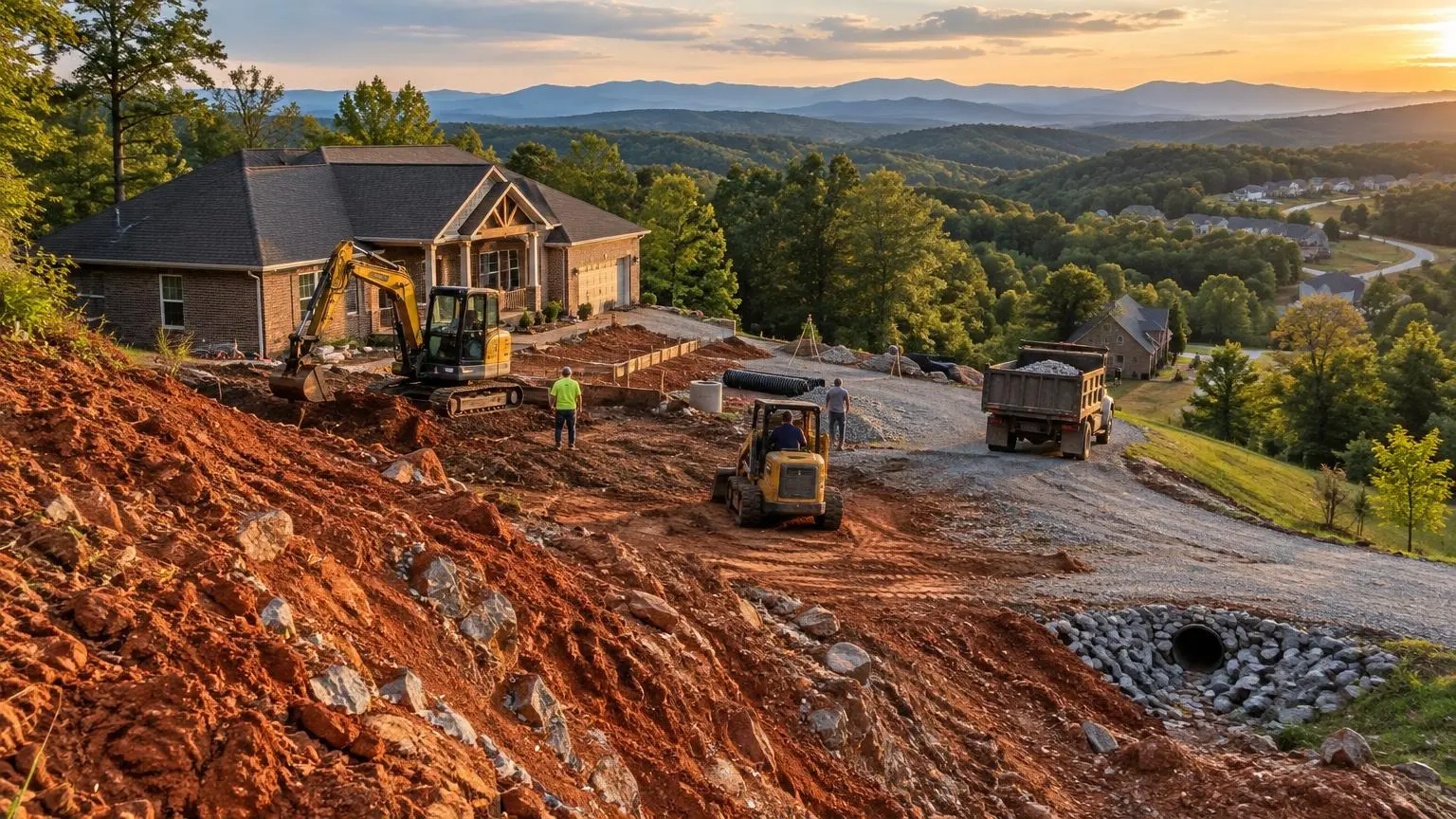
Grading, trenching and digging in red clay, chert and limestone, with water sent where it belongs.
- Free on-site estimates
- Written, line-item pricing before any digging
- Tennessee 811 locate placed before every job
Digging in the Valley Between the Ridges
Excavation contractors in Knoxville work in the middle of the Ridge-and-Valley Appalachians, where long, narrow ridges such as Sharp's Ridge, Beaver Ridge and Brown Mountain run northeast to southwest with broad valleys between them. Elevations run from just over 800 feet at the riverfront to 1,391 feet on top of Sharp's Ridge. Our excavating company grades lots, digs footings, trenches utility lines, installs French drains, builds gravel driveways and clears land for homeowners and small builders across Knox County.
The ground under Knox County
The valleys here are underlain mostly by limestone and dolomite. USDA soil series descriptions for the region's common upland soils tell the story. Dewey soils are red clay weathered from limestone, with bedrock usually more than five feet down, and some areas have sinks and depressions. Fullerton soils formed in cherty limestone and carry 10 to 45 percent chert gravel and cobbles in individual layers. Talbott soils are firm, plastic clay with limestone bedrock 20 to 40 inches below the surface, and the USDA notes karst topography in some areas. Any of the three can show up on one subdivision.
What that means for a dig
- Rock can appear without warning. A footing that goes smoothly on one corner can hit a limestone pinnacle on the next. We price rock as a separate line so you know what changes if we meet it.
- Red clay holds water. When it is wet it is slick, heavy and slow to compact. When it dries it can crack and shrink. Backfill is placed in thin, compacted lifts.
- Chert dulls equipment and sorts poorly. Cherty fill is fine for some uses and wrong for others. We tell you which spoil can stay and which should go.
Sinkholes and water
Tennessee is listed among the states with the most sinkhole damage, alongside Florida, Texas, Alabama, Missouri, Kentucky and Pennsylvania. New collapses often start when people change how water drains in karst ground: ditching, pipeline trenches, roof and driveway runoff and new ponds all speed water downward. So we never point a downspout line, French drain or swale into a depression or an open throat in the rock. If a low spot in your yard looks like a sink, we stop and talk about it before any water goes near it.
Rain, not snow, sets the schedule
Knoxville averages just under 52 inches of precipitation a year and only about 4.6 inches of snow. January's average low is around 30 degrees, so frozen ground rarely stops a machine for long. Long wet spells are the bigger problem, because saturated clay ruts, will not compact and turns a job site into mud. We plan grading and driveway work for drier stretches and keep silt fence and stone at entrances so clay stays out of the street.
Neighborhoods of every age
Knoxville's housing runs from late-19th-century Victorians and Craftsman bungalows in Fourth and Gill, Parkridge and Fort Sanders, through 1920s and 1930s Tudor Revival homes in Sequoyah Hills and Lindbergh Forest, to the Ranch houses that fill the postwar neighborhoods. Older homes bring clay sewer laterals, settled grading and tight access. Newer subdivisions bring cut-and-fill lots where the back of the yard may be fill placed decades ago.
What a typical project looks like
- Free visit to look at the slope, drainage and access
- Written, itemized estimate
- Tennessee 811 locate request and any required permits
- Silt fence and a stone entrance where needed
- Excavation, with topsoil stockpiled apart from clay
- Compacted backfill and a grade that drains away from the house
- Hauling, seed and straw or other restoration as quoted
Why Homeowners Call Excavation Contractors Knoxville
Rock priced up front
Limestone can sit 20 inches or 20 feet down here. Our estimate says how rock is handled and what it costs if we hit it.
Careful with karst
Drain lines and swales go to safe outlets, never into a sink or depression.
Clay handled right
Backfill goes in thin, compacted lifts, and wet clay is not forced into place.
811 before every dig
We request utility marks for every job and wait until they are in.
Clean sites
Stone construction entrances and silt fence keep red clay out of streets and creeks.
Where We Work
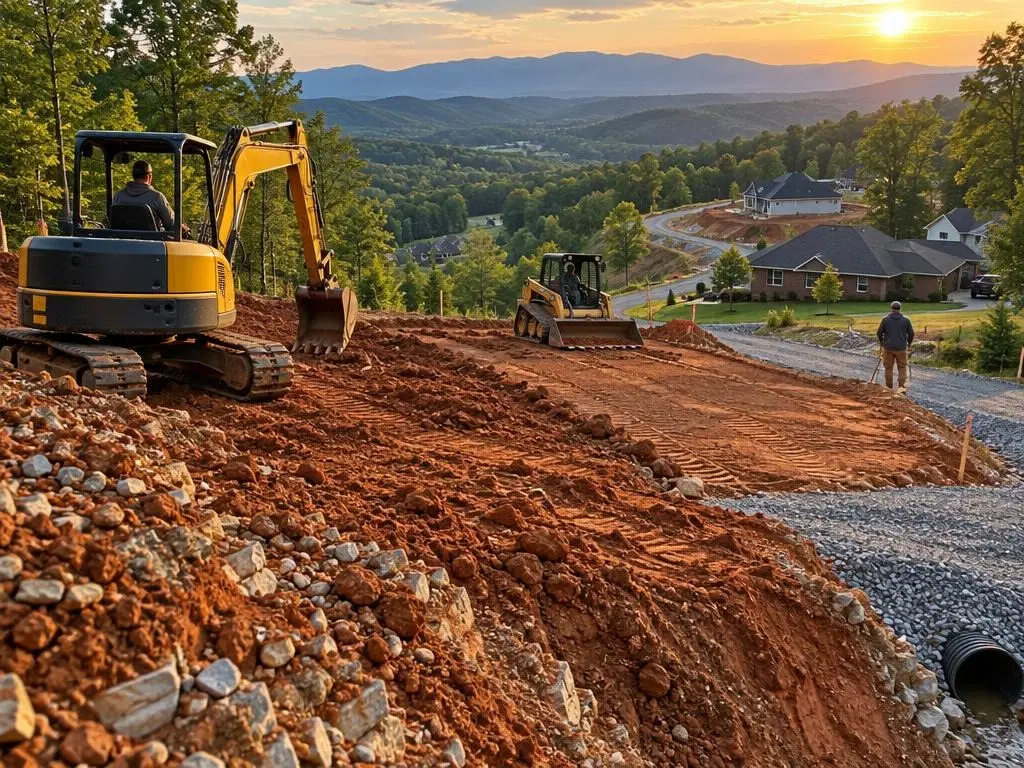
We work throughout Knoxville and Knox County, from Powell, Halls and Corryton in the north to Farragut and Hardin Valley in the west, and into Blount, Anderson, Loudon and Sevier counties. North of the city, communities like Powell, Karns and Halls sit in the Beaver Creek valley between Beaver Ridge and Copper Ridge. To the south, Maryville, Alcoa and Seymour climb toward Chilhowee Mountain and the Smokies foothills. West and southwest, Farragut, Lenoir City and Loudon slope down to Fort Loudoun Lake and the Tennessee River, while Oak Ridge, Clinton and Norris follow the Clinch. Each town page covers the ridges, creeks, housing and local quirks that matter for a dig there.
- Excavation Contractors in Knoxville, TN
- Excavation Contractors in Farragut, TN
- Excavation Contractors in Maryville, TN
- Excavation Contractors in Alcoa, TN
- Excavation Contractors in Oak Ridge, TN
- Excavation Contractors in Powell, TN
- Excavation Contractors in Halls Crossroads, TN
- Excavation Contractors in Karns, TN
- Excavation Contractors in Seymour, TN
- Excavation Contractors in Lenoir City, TN
- Excavation Contractors in Clinton, TN
- Excavation Contractors in Loudon, TN
- Excavation Contractors in Fountain City, TN
- Excavation Contractors in Sevierville, TN
- Excavation Contractors in Hardin Valley, TN
- Excavation Contractors in Louisville, TN
- Excavation Contractors in Corryton, TN
- Excavation Contractors in Norris, TN
- Excavation Contractors in Rockford, TN
- Excavation Contractors in Friendsville, TN
- Excavation Contractors in Kodak, TN
- Excavation Contractors in Sequoyah Hills, TN
- Excavation Contractors in Bearden, TN
- Excavation Contractors in Strawberry Plains, TN
Excavation Services Around Knoxville
Six kinds of dirt work we take on for homeowners, builders and landowners in Knox County.
Lot Grading & Building Pads
Shaping lots, cutting level pads and fixing grades that send water toward the house.
Learn more →Footing & Crawlspace Excavation
Digging footings, crawlspaces and basements for new homes, additions and garages.
Learn more →Water, Sewer & Electrical Trenches
Trenches for water lines, sewer laterals, septic lines, gas and underground power.
Learn more →French Drains & Downspout Lines
Underground drains that collect and carry water away from yards and foundations.
Learn more →Gravel Driveways & Culverts
New gravel driveways, rebuilt washed-out drives and culvert pipes at ditches.
Learn more →Land & Brush Clearing
Clearing trees, brush and stumps to open up building sites, pastures and overgrown lots.
Learn more →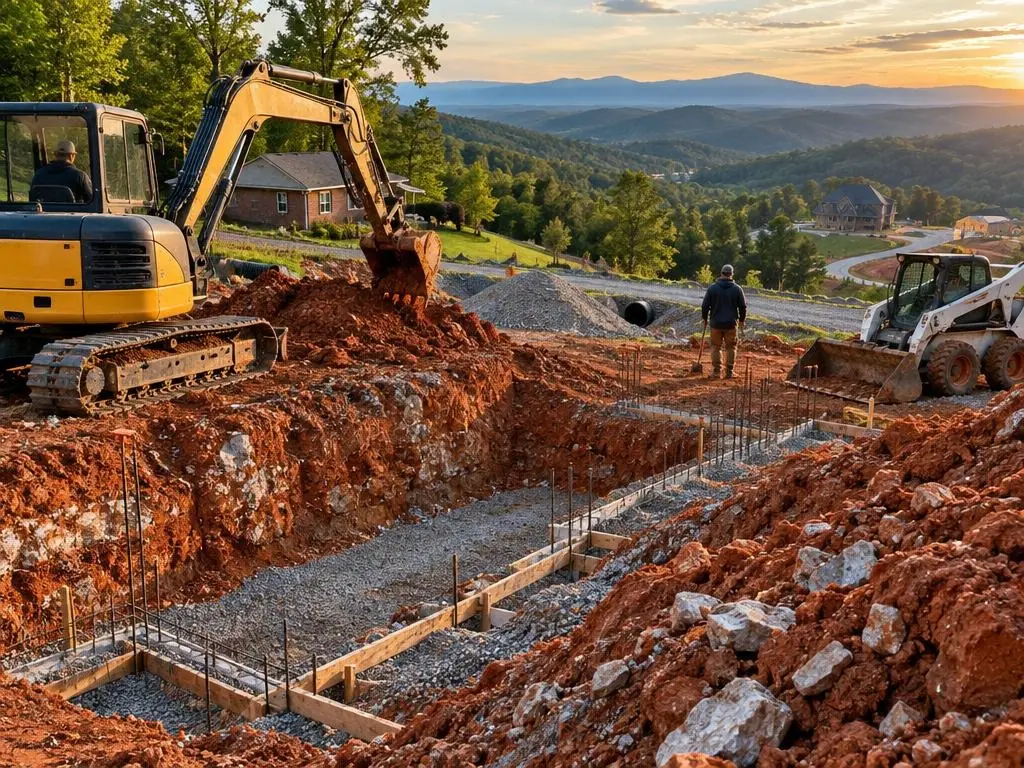
Common Questions
How much do excavation contractors charge in Knoxville?
HomeBlue's Knoxville figures put a machine with operator at about $180 to $310 an hour, or roughly $1,400 to $2,500 for a full day, with hauling at $400 to $600 or more per truckload. A basement dig for a new home runs about $3,600 to $6,300 and a no-basement foundation about $2,200 to $3,800. Rock, access and hauling distance move those numbers, so we quote after seeing the site.
What happens if you hit rock?
It depends on how much and how hard. Small ledges and pinnacles can often be broken with a hydraulic hammer or worked around. Large amounts of solid limestone change the plan and the price. HomeGuide puts rock removal at roughly $50 to $200 per cubic yard when it stays on site. Our estimate spells out how rock is billed so there are no surprises.
Is my property in sinkhole country?
Much of the Knoxville area sits on limestone and dolomite, and the USDA notes sinks, depressions and karst topography on several of the region's common soils. A low, bowl-shaped spot that collects water or opens after heavy rain deserves attention. We point it out if we see one and keep drainage water away from it.
Do I need to call 811 before digging in my yard?
Yes. Tennessee requires anyone excavating to notify Tennessee 811 so buried utilities can be marked first, and that includes homeowners. When we do the work, we place the request and wait for the marks.
What is the best time of year for excavation in East Tennessee?
Late spring through fall is usually best, because the red clay is drier and compacts properly. Winters are mild, with about 4.6 inches of snow a season, so cold rarely stops work, but long rainy spells can. Urgent water and sewer work happens any time.
Do you do small jobs?
Yes. Many jobs are a single day: a French drain along one side of a house, a trench for a water line, a gravel pad for a shed or a regrade of a soggy corner. Most operators, including us, price a minimum, so we will tell you what that is up front.
Can you get a machine into a fenced backyard?
Often. Compact excavators and track loaders fit through many gates, and fence panels can sometimes be removed and replaced. We check gate width, septic fields, slopes and overhead lines during the visit.
Get an Excavation Estimate in Knoxville
Free site visits across Knox County and nearby towns.